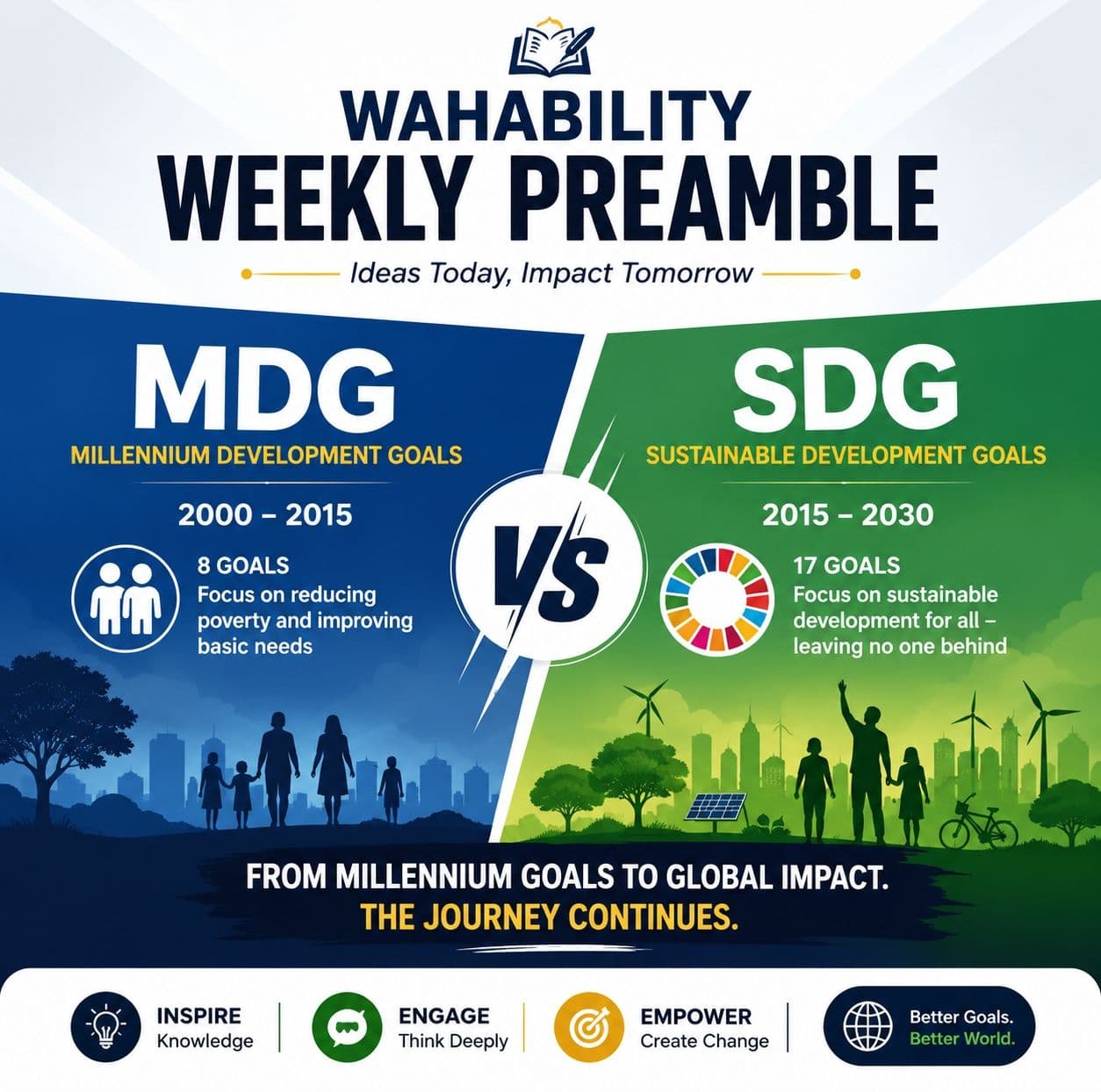
The journey toward global development has evolved from the Millennium Development Goals (MDGs) to the Sustainable Development Goals (SDGs). While both frameworks were designed to improve human welfare and address pressing global challenges, they differ significantly in scope, ambition and approach.
MDGs,
Adopted in 2000, established eight goals with 21 targets, focusing largely on critical development challenges in developing countries. They placed strong emphasis on reducing extreme poverty and hunger, improving access to education, promoting gender equality, reducing child mortality, improving maternal health, combating diseases, ensuring environmental sustainability and strengthening global partnerships.
By 2015, the world had recorded important progress under the MDGs, particularly in poverty reduction, access to primary education and improvements in child and maternal health. However, significant gaps remained. Development was uneven across countries and communities, while issues such as inequality, climate change, governance and sustainable economic development demanded broader attention.
SDGs.
Adopted by all United Nations Member States in 2015, the SDGs expanded the development agenda from eight goals to 17 goals and 169 targets, with a universal ambition: no country and no one should be left behind. Unlike the MDGs, which were primarily focused on developing countries, the SDGs apply to all countries, recognising that sustainable development is a shared responsibility.
The SDGs go beyond measuring development by poverty and basic social services. They incorporate economic growth, decent work, innovation, infrastructure, reduced inequalities, responsible consumption, climate action, peace, justice and strong institutions.
The difference, therefore, is not simply eight goals versus 17 goals. It is a shift from a relatively targeted development framework to a much broader vision of transforming the economic, social, environmental and institutional systems that shape people's lives.
For Nigeria, the transition from MDGs to SDGs presents both an opportunity and a challenge. The country has made progress in several areas, but poverty, unemployment, insecurity, inequality, weak institutions, poor infrastructure and limited access to quality education and healthcare continue to affect development outcomes.
The critical question is no longer whether Nigeria has development plans. The question is whether these plans are effectively implemented, properly funded, transparently monitored and translated into measurable improvements in the lives of citizens.
This is where accountability becomes essential.
Budgets must connect with development priorities. Policies must be supported by reliable data. Public resources must produce measurable results. And governments at federal, state and local levels must understand that achieving the SDGs is not merely a United Nations obligation—it is fundamentally about improving the quality of life of Nigerians.
The MDGs gave the world a roadmap. The SDGs expanded the destination.