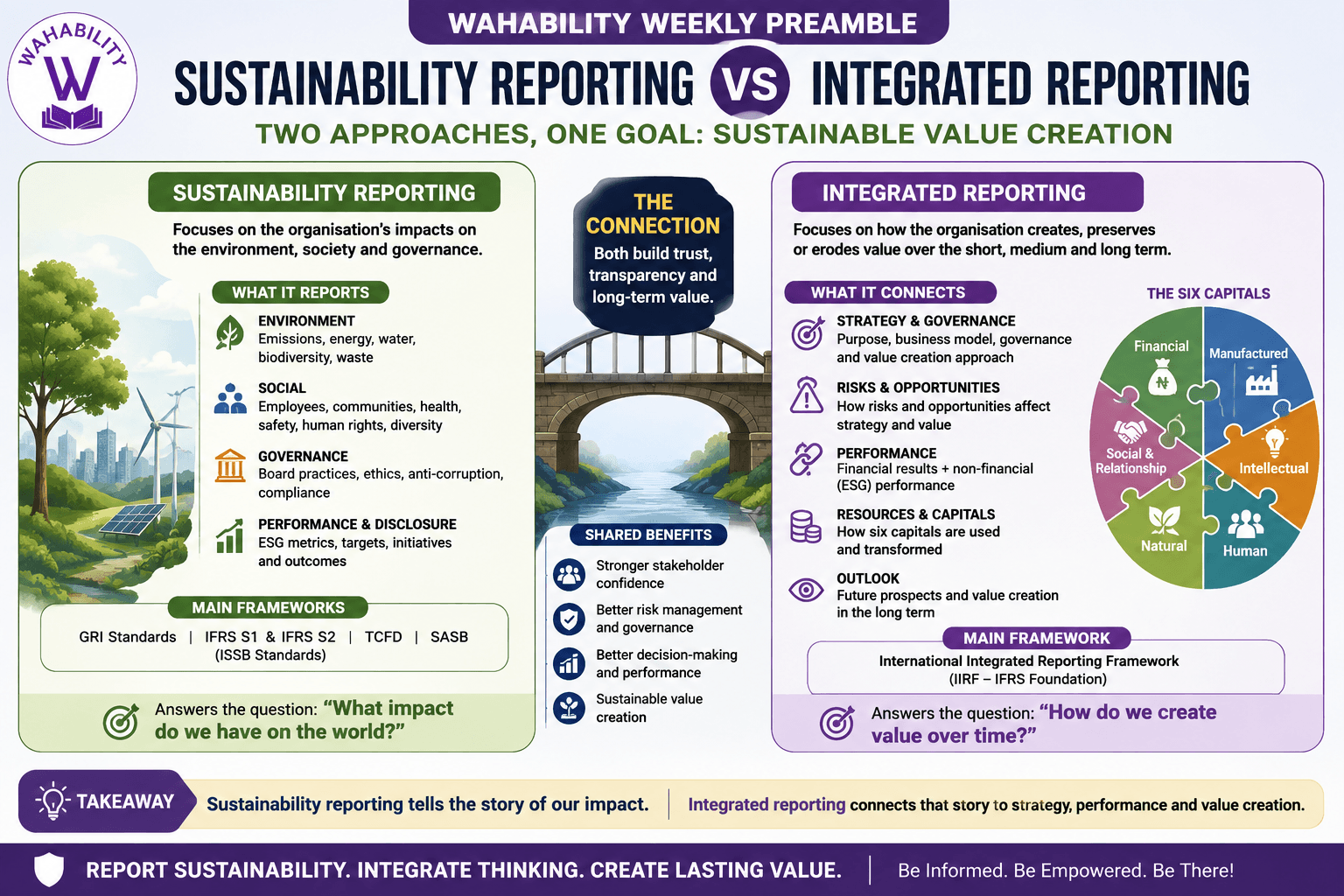
Sustainability Reporting is the disclosure of an organisation’s environmental, social and governance (ESG) impacts, including climate, employees, human rights, community relations and governance.
Integrated Reporting, however, connects financial and non-financial information to explain how an organisation creates, preserves or erodes value over the short, medium and long term.
Key Difference
Sustainability reporting primarily communicates an organisation’s sustainability impacts and performance, while integrated reporting explains the relationship between strategy, governance, financial performance, sustainability and value creation. Integrated reporting is therefore more focused on connectivity and integrated thinking.
Frameworks
Sustainability reporting may be guided by GRI, IFRS S1 and IFRS S2, while Integrated Reporting is guided by the International Integrated Reporting Framework, built around value creation, the six capitals (Financial, Manufactured, Intellectual, Human, Social & relationship and Natural) and integrated thinking.
Benefits
Both approaches improve transparency, accountability, investor confidence, governance, risk management and organisational resilience.
Challenges
Key challenges include data quality, reporting costs, limited expertise, inconsistent measurement, assurance difficulties and greenwashing risks.
Takeaway
Sustainability reporting tells the story of an organisation’s ESG impact; integrated reporting connects that story to strategy, performance and value creation.