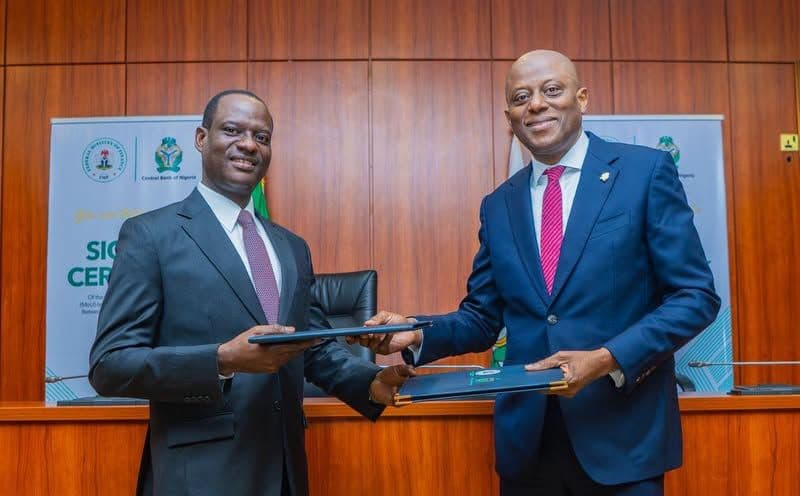


ABUJA — The Central Bank of Nigeria (CBN) and the Federal Ministry of Finance have signed a Memorandum of Understanding (MoU) aimed at strengthening coordination between fiscal and monetary authorities in the management of the Nigerian economy.
The agreement formalises closer collaboration and information sharing between the two institutions on critical areas including inflation, economic growth, government revenue, liquidity management, public financing and exchange-rate management.
According to the institutions, the framework is designed to improve policy alignment while safeguarding the operational independence of the CBN.
The partnership is expected to support efforts towards price stability, sustainable economic growth, financial-system resilience and improved investor confidence.
Speaking at the signing ceremony, CBN Governor, Olayemi Cardoso, reaffirmed the apex bank’s commitment to sound monetary policy and macroeconomic stability, describing the agreement as an important step towards strengthening cooperation in the national interest.
“Today’s signing strengthens an enduring partnership and reinforces our shared commitment to work together in the national interest. Through this partnership, we can help build a more stable and resilient economy that creates greater opportunity for all Nigerians,” Cardoso said.
The Minister of Finance and Coordinating Minister of the Economy, Taiwo Oyedele, stressed the importance of institutional strength to sustainable economic management.
“Strong economies are not built around strong personalities. They are built around strong institutions,” Oyedele said.
The MoU underscores a shared commitment by the CBN and the Ministry of Finance to improve policy coordination and economic outcomes while advancing Nigeria’s stability and sustainable development objectives.
The agreement comes against the backdrop of the need for greater coherence between fiscal and monetary measures in addressing inflation, liquidity, public financing and other macroeconomic challenges confronting the Nigerian economy